
Author: Haruki Murakami; Director: Kazuki Omori
Must be difficult to be asked to write and direct the film adaptation of a novella which had already won a prestigious Gunzo literary award. Then again, director Kazuki Omori, who would go on to direct Godzilla in two Heisei-era romps (vs. Biollante in ‘89 and vs. King Ghidorah in ‘91), would not know that he would be handling the debut work of an author who would later win several prizes and be dubbed “among the world's greatest living novelists” among other accolades. He would however know what a task it would be to write and adapt a book essentially about nothing.
To be fair, Haruki Murakami (The Wind-Up Bird Chronicle, Norwegian Wood) didn’t write his book about the same nothing as Seinfeld’s. Rather, Hear the Wind Sing is a pastiche of characters who seemingly wander from one in-novel set piece to the next, interacting with each other as if delivering monologue. This quiet-cool, hard boiled style has earned Murakami accolades as well as criticisms from those who accuse him of being a stylistic one trick pony.
The novella feels like it could have been at least partially autobiographical for Murakami in 1979. It essentially follows a nameless protagonist’s return to his hometown during a break from school. Within in the narrative are scenes and ruminations on relationships, music (jazz and rock and roll), beer, cigarettes, class inequality, french fries, and pinball. Hear the Wind Sing feels aimless but at the same time fits a post-modern “going nowhere but looking good while doing so” aesthetic.
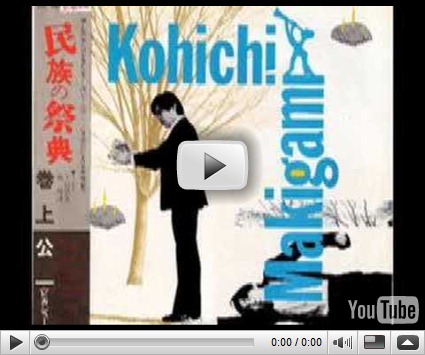
The movie Hear the Wind Sing then is an attempt to ride that aesthetic visually. At first, the cast don’t seem up to the task of replicating their text counterparts. Kaoru Kobayashi, normally an excellent actor, looks rather nebbish for the part and narrates Murakami’s prose rather woodenly. Kimie Shingyoji, who resembles a younger, more beautiful Eihi Shiina (Audition, Tokyo Gore Police), plays her character, a recurring woman in the narrator’s short return home, seemingly with ice running through her veins. Koichi Makigami, a highly talented musician and vocalist (see YouTube clip below), certainly looks the part of his character (named “The Rat”) with his rodent-like wide cheeks and squinty features but hardly emanates the coolness of a Murakami character.
Director Omori, who also wrote the screenplay, however, did try to create visuals which matched the quirkiness of the novella. There are several sepia-toned and black and white flashbacks, stock clips of ‘60s Japanese student movement riots, a funny and surreal film-within-the-film sequence, and even animation scenes that reflect the novella’s sometimes patch-work like construction. While interesting, the shifts can sometimes feel jarring and sometimes add unnecessary visual noise. Somewhere along the way, however, Omori manages to put both disparate elements in his film together and make them work. It can be said that some novels but especially Murakami’s have to exist in their own worlds. The casting and stylistic issues seem at first like missteps because they feel too much a part of a movie world and not Murakami’s world, a shift that does not occur until halfway through. If Omori had been able to figure out how to start in Murakami’s world earlier, the movie would have worked better but once the first chords of “California Girls”, a recurring piece on the soundtrack (which has an eclectic mix of bop, free jazz, early electronic music, and rock), kick in for the first time then we know Omori has made the shift.
Murakami’s work has been likened to music (c.f. Haruki Murakami and the Music of Words by Jay Rubin) not surprisingly considering he constantly references musicians, primarily western ones, in his stories. Stylistically, as any musician can tell you, what’s not played is as important as what is played. A drumbeat, for example, is typically definable by the space between beats as much as the beats themselves. Murakami’s style very much fits this metaphor in that he gives the reader just enough to be able to fill in any spaces left empty in the narrative. That Omori could take this style and make a good film out of it is a feat akin to making something out of nothing.
Hear the Wind Sing, the novella, was never released outside of Japan. An English-translated version exists but is currently out of print. The movie also was never released outside of Japan but can be viewed on YouTube without subtitles here.


 Posts
Posts


